(By Seda Tubay)
Executive Summary
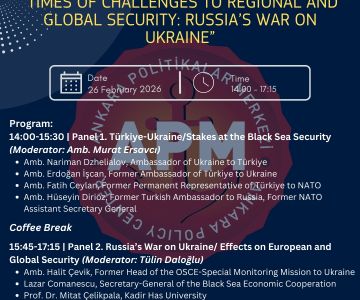
The conference titled “Times of Challenges to Regional and Global Security: Russia’s War on Ukraine” brought together policymakers, diplomats, scholars, and practitioners to examine the ongoing conflict in Ukraine and its implications for regional and global security. The panels highlighted multiple dimensions of the war, including military, political, legal, economic, and humanitarian aspects, with a special focus on the Black Sea region, NATO strategy, and international cooperation.
Panel 1. Türkiye- Ukraine/Stakes at the Black Sea Security (14.00-15.30) Key Highlights:
- Russia’s invasion poses threats far beyond Ukraine, affecting Europe, the South Caucasus, the Middle East, and global stability.
- Ukraine has shown resilience, reinforcing its sovereignty and nation-state identity.
- Turkey plays a strategic role, enabling initiatives like the Black Sea Grain Initiative and maintaining maritime stability.
- NATO’s deterrence and defense pillars remain crucial; effectiveness depends on both military capabilities and clear political will.
- Multi-domain approaches are required to address hybrid threats and ensure Black Sea and European security.
1. Opening (14.00)
Moderator: Amb. (E) Murat Ersavcı, International Studies Center Director of TEPAV
The meeting began with an opening speech by moderator Murat Ersavcı. Ersavcı thanked the Ankara Policy Center and Foreign Policy Institute for their contributions to the organization and emphasized the importance of this meeting, which brought together policymakers, diplomats, academics, and practitioners from different fields.
Ersavcı noted that at the beginning of Russia’s invasion of Ukraine, many observers thought it would be short-lived, but the war has become one of today’s defining geopolitical events. Ukraine’s resistance in defending its sovereignty and territorial integrity was highlighted, along with the war’s far-reaching effects on European security architecture, energy markets, food security, and defense policies.
It was stated that Turkey occupies a sensitive and strategic position as a Black Sea country, a NATO ally, and a regional actor. Ersavcı pointed out that the panel discussions would make important contributions to Turkey’s national security and the objective of striking regional balance, and gave the floor to Nariman Dzhelialov as the first speaker.
2. Nariman Dzhelialov, Ambassador of Ukraine for Türkiye
In his speech, Dzhelialov summarized the impact of Russia’s invasion of Ukraine on regional and global security. The following points stood out in his speech: He expressed his pleasure at contributing to the event and thanked the organizing institutions. He emphasized that the war has been going on for 1,464 days and that the situation in the Black Sea poses a serious threat to Europe, the South Caucasus, and the Middle East. He stated that Turkey’s support as a strategic partner, and in particular its decision to close the Straits in 2022, played an important role in the military balance in the Black Sea. Attention was drawn to Turkey’s contribution to the formation of the Black Sea Grain Initiative and the Ukraine Maritime Corridor. It was stated that Turkey’s control over the Straits and its commitment to the Montreux Convention of 1936 are critical for regional stability. It was emphasized that Black Sea security is the shared responsibility not only of the littoral states but also of all European and NATO allies. Attention was drawn to the increase in hybrid threats in the region. It was stated that Turkey and Ukraine are working together in the context of economic cooperation and global food security. It was stated that Ukraine’s goal is to end Russian dominance in the Black Sea.
It was emphasized that the resistance that began in 2014 against the occupation of Crimea is an important symbol of Ukraine’s struggle for sovereignty. At the end of his speech, Dzhelialov stated that the panel would contribute to a better understanding of regional and global security dynamics.
3. Amb. Erdoğan İşcan, Former Ambassador of Türkiye to Ukraine
Former Turkish Ambassador to Kyiv, Erdoğan İşcan, addressed Russia’s aggression against Ukraine from the perspective of international law, offering a comprehensive assessment of the war within a broader historical, legal, and strategic framework. According to İşcan, the prohibition of the use of force enshrined in the UN Charter remains a cornerstone of the international legal order, and the international community must remain united in defending these principles.
İşcan also emphasized the strategic importance of the Black Sea region, describing it as a critical area for Europe’s peace and security. He expressed agreement with previous speakers regarding the importance of Türkiye–Ukraine cooperation in ensuring sustainable regional stability. Drawing on his experience as former Ambassador of Türkiye to Ukraine, he extended his best wishes to the current Ukrainian Ambassador for a successful tenure in Ankara.
In addressing the origins of the conflict, İşcan referred to the 2008 NATO Bucharest Summit, recalling that there had been no consensus within NATO regarding the future membership of Ukraine and Georgia. He noted that the divisions within the Alliance and Russia’s response to these developments significantly influenced the evolving security dynamics of the region. He also raised the question of whether the war that began in 2022 could be ended through diplomatic means that respect Ukraine’s sovereignty and territorial integrity.
Overall, İşcan’s remarks provided a nuanced and multidimensional evaluation of the war, emphasizing not only its legal implications but also its broader strategic consequences for European stability, global governance, and the future of international peace and security.
4. Amb. (E) Fatih Ceylan, Former Permanent Representative of Türkiye to NATO
Fatih Ceylan, former Permanent Representative of Turkey to NATO, provided a comprehensive analysis of security developments in the Black Sea region in light of Russia’s ongoing war against Ukraine. He emphasized that the security of the Black Sea is intrinsically linked to the security of
Ukraine, as well as broader European and Eurasian security frameworks. According to Ceylan, Russia’s military aggression has accelerated the militarization of the region, effectively transforming the Black Sea into a strategic frontline of European security.
Ceylan situated the current conflict within a broader historical and geopolitical context, noting the Russo-Georgian War of 2008, the illegal occupation and annexation of Crimea in 2014, and Russia’s full-scale invasion of Ukraine in 2022. These successive developments have collectively reshaped the strategic environment of the Black Sea, establishing it as a critical arena of geopolitical competition. The expansion of Russia’s Black Sea presence has enhanced its capacity to project power throughout the region and beyond.
He further highlighted that threats in the Black Sea extend beyond traditional military challenges. Russia increasingly employs hybrid tactics, including excessive militarization, disinformation campaigns, economic coercion, and energy manipulation. These measures undermine freedom of navigation, jeopardize food security, and threaten critical infrastructure such as ports and energy networks.
Ceylan also underscored Turkey’s stabilizing role in the Black Sea. Through air policing, intelligence operations, surveillance, naval deployments, and joint capacity-building initiatives with allied partners, Turkey contributes substantially to regional security and stability. He argued that addressing Black Sea security necessitates a comprehensive, multi-domain strategy integrating military, economic, energy, and informational dimensions. By adopting such an approach, Turkey functions not only as a security provider but also as a generator of regional stability. Ceylan’s analysis reinforces the view that the Black Sea is not a peripheral zone but a strategically vital region, forming the southeastern flank of NATO and serving as a critical interface between Euro-Atlantic and Eastern security theaters. Effective security policies in the Black Sea must therefore consider its multi-dimensional challenges and its integral role in broader European and Eurasian security.
5. Amb. Hüseyin Diriöz, Former Turkish Ambassador to Russia, Former NATO Assistant Secretary General
Hüseyin Diriöz addressed the effectiveness of NATO’s deterrence strategy and the importance of alliance cohesion in the context of contemporary security challenges, particularly the war in Ukraine.
In his remarks, Diröz emphasized that “deterrence and defense” constitute the core pillars of NATO’s strategic concept, later complemented by “crisis management” and “cooperative security” in the post-Cold War era. However, he noted that cooperative security has not functioned as effectively as intended. Both Erdoğan İşcan and Hüseyin Diriöz emphasized that Russia’s war against Ukraine is a clear violation of international law and poses a serious threat to regional and global security. İşcan approaches the issue more from a legal and historical perspective, highlighting the breach of the United Nations Charter, the implications of the NATO enlargement debates, particularly the 2008 Bucharest NATO Summit, and questioning whether the war could have been prevented. He also draws attention to the broader humanitarian and economic consequences of the conflict and situates it within one of the most fragile security environments since the Cold War. Diriöz focuses more on NATO’s strategic framework and the practical aspects of deterrence and defense. He underlines that NATO’s core pillars of deterrence and defense, alongside crisis management and cooperative security are directly challenged by the war. His emphasis on the necessity of strong military capacity and political will complements İşcan’s legal assessment by adding a strategic and policy-oriented dimension.
Importantly, both figures converge on the need for a just and lasting peace grounded in international law. While İşcan raises critical questions about prevention and consequences, Diriöz offers a forward-looking perspective by stressing continued international support for Ukraine and highlighting Türkiye’s potential role as a key actor in facilitating conflict resolution.
In this sense, the two statements overlap and reinforce one another: İşcan provides the legal-historical framework, while Diriöz strengthens it with strategic and diplomatic insights. Together, they form a coherent and comprehensive analysis of the war and its implications.
Additionally, he referred to ongoing debates about the long-term solidity of NATO and the possibility of alternative security mechanisms, suggesting that such discussions may signal underlying vulnerabilities in alliance unity. Finally, Diröz underlined Türkiye’s constructive role in the current security environment. He highlighted Türkiye’s contributions in the Black Sea, including facilitating logistical arrangements such as the grain initiative, supporting prisoner exchanges, and promoting cohesion within the alliance.
Panel 2. Russia’s War on Ukraine/Effects on European & Global Security (15.45-17.15) Key Highlights:
- The conflict has political, military, economic, societal, and humanitarian implications with regional and global reach.
- Ukraine has transformed into a stronger, more cohesive nation; Western support has enhanced its armed forces.
- Security is multi-dimensional: military, economic, energy, and infrastructure components are all vital.
- Türkiye is a strategic hub for logistics, humanitarian aid, and food security initiatives.
- The Black Sea region is critical for European stability, trade security, and multilateral cooperation.
- Humanitarian crises remain significant: millions are displaced or require assistance; initiatives like the Black Sea Grain Initiative have reduced global food price volatility.
- Russia is increasingly seen as a persistent threat to European security, emphasizing the need for sustained international engagement and post-conflict reconstruction planning.
Moderator : Tülin Daloğlu, U.S. Center Director of TEPAV
In the context of the event, Tülin Daloğlu served as the moderator for one of the key discussion panels, guiding dialogue among senior experts and speakers on issues such as security trends and strategic policy challenges.
5. Amb. Halit Çevik, Former Head of the OSCE-Special Monitoring Mission to Ukraine
Çevik highlighted that Ukraine has developed a stronger sense of nation-state identity throughout the course of the war. According to him, Russia’s aggression has unintentionally contributed to strengthening Ukrainian national unity and state identity.
He also pointed out the substantial transformation experienced by the Ukrainian Armed Forces during the conflict. Çevik noted that since the beginning of the war, the Ukrainian military has evolved into a stronger, more experienced, and more effective fighting force. In this process, the support provided by Western partners has played a critical role in enhancing Ukraine’s defense capabilities.
Addressing the broader security implications, Çevik emphasized that the war in Ukraine should not be viewed as a purely bilateral conflict. Instead, it must be understood within the context of wider geopolitical developments and the growing competition among major powers. In his view, these dynamics have significantly affected the European security architecture.
Çevik referred to Russia’s initial objectives at the beginning of the war, noting that Moscow’s strategy aimed to limit Ukraine’s sovereignty and draw the country back into Russia’s sphere of influence. His remarks underlined that the conflict represents not only a territorial dispute but also a struggle over political orientation and geopolitical alignment in the region.
6. Lazar Comanescu, Secretary General of theBlack Sea Economic Cooperation Organization (BSEC)
Comanescu noted that discussions on whether the war affects European security are no longer theoretical. He stressed that the impact can be clearly observed through public opinion trends across Europe, disruptions in trade flows, deteriorations in food and energy supply security, and the tragic developments unfolding on the ground. Highlighting that security is a multidimensional concept, Comanescu underlined that economic security is just as critical as military security. He pointed out that the security of supply chains, continuity of trade flows, food availability, and energy security are all integral components of overall security. In this context, he emphasized the strategic importance of the Black Sea region.
Comanescu also noted that the Black Sea Economic Cooperation Organization (BSEC) had been significantly affected by the war. He recalled that the organization had clearly stated that the attack against Ukraine constituted a violation of international law. While the organization’s activities had temporarily slowed down due to the conflict, he explained that its work had gradually returned to normal. He further stated that BSEC had revitalized its Project Development Fund and strengthened project-based cooperation within the region.
Comanescu emphasized that cooperation between the European Union (EU) and BSEC is of particular importance. Welcoming the EU’s newly adopted regional strategic approach last year, he added that the implementation of this strategy should take into account the projects already being developed within the region.
7. Ege Seçkin, Emergency Response Officer of the United Nations World Food Programme (WFP) in Türkiye
Seçkin addressed the humanitarian and food security dimensions of the war in Ukraine, emphasizing that the conflict has had far-reaching consequences not only for regional stability but also for global food security. He underlined that the strategic connection between Türkiye and Ukraine plays a critical role in sustaining global food supply chains and directly affects the lives of millions of people worldwide. Seçkin began by noting that the World Food Programme is the largest humanitarian organization in the world, operating in more than 120 countries and territories. He stated that WFP aims to reach approximately 100 million people globally in 2026, stressing that in many crisis contexts the organization’s presence represents the difference between life and death for vulnerable populations.
Highlighting WFP’s operations in Ukraine, Seçkin explained that the organization has been conducting a large-scale humanitarian operation in the country since 2022. Ukraine currently represents one of WFP’s five largest operations globally, alongside other major crisis areas such as Gaza, Sudan, and Afghanistan. According to Seçkin, the scale of humanitarian needs in Ukraine remains significant as the war continues.
Seçkin also emphasized Türkiye’s unique position within WFP’s global supply chain. Since 2019, the organization has procured approximately 2.5 billion dollars’ worth of food products from Türkiye, making the country one of WFP’s largest suppliers. A significant portion of these supplies consists of wheat flour and wheat-based products. Thanks to its geographical proximity to crisis regions such as Gaza, Syria, Sudan, and Ukraine, Türkiye has emerged as a key logistical and processing hub for humanitarian food assistance.
In this context, Seçkin highlighted the importance of the Black Sea Grain Initiative, which he described as a strategic mechanism linking Ukraine’s agricultural production to global food security. According to Seçkin, the initiative functioned both as an economic lifeline for Ukraine and a humanitarian lifeline for the rest of the world. During the approximately one-year period when the initiative was in effect, global food prices declined by around 20 percent, providing considerable relief to fragile economies as well as humanitarian organizations operating under tight resource constraints.
Although the initiative has ended, Seçkin noted that grain exports from Ukraine continue through alternative routes. Within this framework, WFP has also supported the “Grain from Ukraine” initiative, through which agricultural products from Ukraine are processed in Türkiye and delivered to countries facing food insecurity.
Turning to the humanitarian situation inside Ukraine, Seçkin cited United Nations data indicating that
10.8 million people in the country require humanitarian assistance as of 2026, while approximately 3.7 million people remain internally displaced. In 2024 alone, WFP reached 2.9 million people, representing roughly 10 percent of the country’s population. Seçkin drew attention to the operational challenges of delivering humanitarian aid in an active conflict environment. He noted that destroyed bridges, damaged roads, and degraded infrastructure significantly complicate the delivery of assistance, particularly to communities located near front lines. He also recalled that eight humanitarian aid workers lost their lives in Ukraine in 2025, and that a WFP warehouse was struck by a drone attack, though fortunately without casualties. Seçkin concluded by emphasizing the need for sustained international cooperation to maintain humanitarian access and protect global food security in the face of the ongoing conflict.
8. Prof. Dr. Mitat Çelikpala, Vice-Rector of Kadir Has University,
Çelikpala addressed the ongoing transformation of the European and global security architecture as Russia’s full-scale invasion of Ukraine enters its fifth year. He emphasized that the conflict is no longer solely about Ukraine, but fundamentally concerns how European security itself will be defined.
Çelikpala highlighted the gravity of the war reaching its fifth year and expressed hope that future discussions would focus not on the conflict, but on Ukraine’s reconstruction, the restoration of its territorial integrity, and support for Ukraine as a sovereign state.
He stressed that the war continues both on the frontlines and in civilian areas, noting that Russia’s attacks on energy and civilian infrastructure have targeted essential services such as electricity, heating, and water. While acknowledging ongoing peace efforts, Çelikpala pointed out that attritional dynamics persist, making not only the cessation of hostilities but also the strengthening of Ukraine’s reconstruction and governance capacity a core concern.
Çelikpala also highlighted that Russia has increasingly come to be seen as a clear threat to Europe. He referred to statements by several European leaders warning of potential new security threats stemming from Russia through 2030, underscoring that the conflict’s implications extend well beyond Ukraine itself.
9. Closing (17.15)
Discussions highlighted:
- The interconnection between Ukraine’s security, Black Sea stability, and European security architecture.
- The importance of adhering to international law, NATO cohesion, and multilateral cooperation.
- The critical humanitarian and economic dimensions of the war, with Türkiye as a central regional partner.
- Reconstruction, governance, and resilience as key priorities for post-conflict planning.
The panel titled “Times of Challenges to Regional and Global Security: Russia’s War on Ukraine” concluded with a question-and-answer session, providing participants the opportunity to engage directly with the speakers and discuss key insights, perspectives, and implications of the ongoing conflict. This interactive segment allowed for a dynamic exchange of ideas, consolidating the discussions on both regional and global security consequences of the war.
(By Seda Tubay)