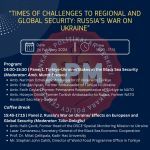
24 February 2026 marked the fourth year since the Russian Federation launched full-scale invasion of Ukraine, in violation of the United Nations Charter and international law.
Indeed, we are living through challenging times, unprecedented since the end of the Second World War.
The international security architecture, based on the rule of international law, is under fierce attack. There is a growing trend for the law of power to prevail the rule of law. Multilateral institutions are under assault on many fronts. The balance of power is being restructured. The prospects are in the making, though not yet clearly identifiable. I think the end result will depend on resilience of the proponents of multilateralism and the rule of law at national and international levels.
Under such circumstances, strategic objectives must take into account the requirements of realpolitik. A proper balance needs to be established between ideal and feasible objectives. Tactical moves must be devised accordingly. This principle is valid also for ending the ongoing regional conflicts, including Russia’s war on Ukraine.
I believe the topic could be discussed in connection with three questions:
First, the question whether Russia’s full-scale invasion of Ukraine could have been prevented.
Second, the need to address the catastrophic humanitarian and economic consequences of the war.
Third, the prospect of reaching a just and lasting settlement in compliance with international law.
In short, these questions relate to the past, the present and the future of the devastating war.
At the outset, I wish to set the record straight with respect to my principal position on the current war.
It is unquestionable that the Russian aggression against Ukraine is a flagrant violation of international law, including in particular international humanitarian and human rights law. It constitutes an attack on the fundamental principle that is explicitly enshrined in article 2 paragraph 4 of the United Nations Charter. Refraining from the threat or use of force against territorial integrity or political independence has been a core obligation for global peace and security. Russia must be held to account for such a manifest breach of international law. It goes without saying that this principle applies to all who perpetrate similar violations of international law.
I will raise certain remarks or questions of critical nature in search of the underlying reasons for the emergence of the conflict with a view to seeing the picture more clearly. They will in no way undermine or contradict my principal position.
I will first address the issues under the first question, that is, whether Russia’s war on Ukraine could have been prevented.
Was Russia’s attack unforeseen?
For those who have been following the evolution of Russian politics, the answer would probably be “no, it was not unforeseen”.
I would suggest to revisit the chain of the major events in the last almost two decades.
I will first refer to the Russian position in response to the conclusions of the NATO Summit held in Bucharest in April 2008. I was based in Ukraine and followed the developments as part of the NATO Contact Group. I remember that there was no unanimity within NATO in respect of concerns about acceding Ukraine and Georgia to Membership Action Plan (MAP), which would constitute a significant step towards membership.
The NATO Summit in April 2008 was followed by Russia’s attack on Georgia in August 2008.
A couple of years later, in the wake of the “Maidan protests” in 2013 and 2014, the then President Yanukovich chose to flee Ukraine in February 2014.
In March 2014, Russia invaded and then annexed Crimea.
In February 2022, Russia launched a full-scale invasion of Ukraine, which I consider to be the continuation of the 2014 invasion.
In the aftermath of the annexation of Crimea, I had been cautiously optimistic that steps would be taken to pre-empt a full-scale war. I had not ruled out that option as the worst-case scenario. I had voiced such concerns in my articles prior to February 2022.
I think the war could have been prevented by pursuing alternative postures at two layers. Ukraine as well as its Western allies should have foreseen the potential act of aggression and adopted policies to eliminate such probability. They should have adopted a realistic course of action to deter the potential aggressor. A number of questions with respect to positions that were pursued during that period continue to remain unanswered.
I am still curious what might have prevented the Minsk Agreements of 2015 from taking effect. The United Nations Security Council resolution 2202 (2015), adopted on 17 February 2015, unanimously endorsed the “Package of Measures for the Implementation of the Minsk Agreements, adopted and signed in Minsk on 12 February 2015”. The Package was appended to the resolution as Annex I.
The resolution also welcomed the Declaration by Russia, Ukraine, France, and Germany in support of the Package, adopted in Minsk on 12 February 2015. The Declaration was appended to the resolution as Annex II.
The Declaration in support of the Package was signed at the highest political level by the President of Russia, the President of Ukraine, the President of France and the Chancellor of Germany.
Evidently, under the United Nations Charter, the Security Council decisions are legally binding. All Member States are obligated to comply with the Council decisions.
The circumstances leading to non-implementation of the Security Council resolution 2202 of 17 February 2015, endorsing the Minsk Agreements of 12 February 2015, need to be explored. If implemented, could it have possibly pre-empted the full-scale invasion?
I have another question in mind that has remained unanswered so far.
At the beginning stages of the conflict, negotiations were held in Istanbul in March 2022, between the delegations of Ukraine and Russia. An apparent optimism was being observed regarding the outcome of the talks. But somehow the talks were discontinued and the delegations left the table.
If the negotiations in Istanbul in March 2022 had not been broken, could the war have been ended quickly? I think the question is yet to be answered, if not now, probably by historians in the future.
Let me turn to the second question related to humanitarian and economic consequences of the war on Ukraine.
This is a war of attrition. The longer the war continues, the deadlier it becomes, the greater the suffering and the greater the risk for regional and international peace and security.
The data based on the United Nations, the European Union as well the Ukrainian Government sources demonstrates the size of the humanitarian tragedy and the economic destruction.
More than one and a half million soldiers have already died or been wounded.
More than 15 thousand civilians have been killed and more than 41 thousand injured in Ukraine since the start of the invasion.
Millions of people have been displaced internally or registered in various countries as refugees. The longer the conflict continues, the less likely it is that they will come back.
The plight of Ukrainian children is particularly dire. Many have been killed or injured. A whole generation has lost years of education.
Even before the war, Ukraine’s population density was low and diminishing. In 2021, before the Russian full-scale invasion, Ukraine’s population was around 41 million, down from 52 million at the outset when it became independent. In the last four years, those who lost their lives, those who had to migrate and those who live under occupation amount to almost ten million.
14% of all housing in the country has been damaged or destroyed, displacing and impacting over three million households. That amounts to one in every seven houses.
According to the latest Rapid Damage and Needs Assessment (RDNA5), jointly prepared by the Ukrainian Government, the World Bank, the European Commission and the United Nations, published last Monday on 23 February 2026, reconstruction and recovery in Ukraine will cost around $588 billion over the next decade. This amount is nearly three times the estimated GDP of Ukraine in 2025.
According to the recent figures released by the Armed Forces of Ukraine, a single day of full-scale war costed the country on average $172 million in 2025. In 2024, the average daily cost was around $140 million. The 2025 figure represents an increase of 23% as compared to the 2024 figure.
Ukraine is allocating over 30% of its GDP to military budget. By comparison, most peacetime European nations are struggling to meet the baseline NATO target of 2%.
Such expenditure places the Ukrainian economy under immense pressure with long-term implications. Western financial aid is the only support preventing economic collapse.
The unanimity rule constrains the European Union in sustaining its support to Ukraine. The latest example is quite telling. The €90 billion loan for Ukraine did not go through due to a veto by a member. The same member also vetoed the 20th package of sanctions against Russia.
I have been raising this concern in regard to the sustainability of external support from the outset of the Russian aggression. No State is immune from domestic political controversies and governments face escalating public pressure.
It appears that it is getting increasingly problematic for the European Union to sustain its support.
In the meantime, the current United States administration seems to have revised its priorities and its foreign policy outlook.
This brings me to my final topic, that is, the prospect of reaching a just and lasting settlement in compliance with international law.
I am not in a position to give advice to any party. I am not in possession of substantive information on the current state of negotiations. Thus, I can only share my theoretical vision of a realistic option to end the devastating effects of this war.
On 24 February 2026, both the UN General Assembly as well as the Security Council held meetings on Ukraine.
The General Assembly met in an emergency special session. It adopted a resolution, titled “Support for lasting peace in Ukraine”. It was adopted with 107 votes in favour, 12 against and 51 abstentions. In addition to the fact that the General Assembly decision are not legally binding, the votes in favour represent 55 per cent of the UN membership, demonstrating a split composition.
The debate in the Security Council was inconclusive owing to the fact that positions of the parties still remain hardly reconcilable.
Under such circumstances, the realistic path to peace seems to hinge on a ceasefire and external diplomatic tracks rather than unified Security Council action.
I think the first step might be to get the parties to agree on implementing an immediate moratorium on all attacks on civilians and civilian infrastructure. We should bear in mind that the ongoing fighting also poses direct risk to the safe and secure operations of Ukraine’s nuclear sites. This might have dangerous regional and even global implications.
The following step might be to reach an agreement on a full and unconditional ceasefire which would open the gate for diplomatic negotiations aimed at just, lasting and comprehensive peace.
Realistically, having regard to the deeply divergent and thus not easily reconcilable positions of the parties to the conflict, it looks highly unlikely that the differences might be narrowed soon with a view to reaching a compromise. Nonetheless, as long as diplomatic negotiations are under way, the conflict will remain frozen and the catastrophic humanitarian and economic consequences will be paused.
Such a formula seems to present a realistic and feasible path at this juncture.